DIVINE GRACE (in English)

Avatar de l’utilisateur
InHocSignoVinces
Messages : 2999
Inscription : dim. 26 août 2018 11:43
Localisation : Tharsis, Hispania

Re: DIVINE GRACE (in English)

Message par InHocSignoVinces »

Hope in God must be joined to faith in
Him.
That the sinner be justified he must
believe and hope in God.
Faith is the foundation
of hope. If we believe in God and
therefore believe His promises, we naturally
hope to receive that which He has promised.
If we believe that Jesus, the Son of God,
died on the cross to save us from sin, to
make us children of God and heirs of heaven,
we will naturally hope to benefit by this
mercy of God if we do what He demands
of us.
He who wishes to be justified must
therefore believe in God, he must believe in
Jesus, the Son of God, he must believe that
Jesus redeemed us by His death on the
cross, and that God will pardon his sins on
account of the merits of Jesus Christ; he
must believe that God will give him grace
to live a good life and merit the eternal
happiness of heaven. With belief must be
joined the hope of obtaining heaven through
the grace given him by the merits of his
Redeemer.
Faith without hope is nothing.
Of what use is it to me to believe that Jesus
died for me if I do not hope to be saved
through His death?
It is precisely hope
that lifts us up to God and gives us strength
to do His will and obey His commandments.


To be continued...
Image
Avatar de l’utilisateur
InHocSignoVinces
Messages : 2999
Inscription : dim. 26 août 2018 11:43
Localisation : Tharsis, Hispania

Re: DIVINE GRACE (in English)

Message par InHocSignoVinces »

Besides faith and hope a beginning of the
love of God
is also necessary. We say a
beginning of love,
because the fulness of the
love of God belongs to those that are already
sanctified by grace.
Justification is nothing
but the passing from the state of enmity to
that of the love of God. He who wishes
to be justified must long to be holy and to
be a child of God. This longing is nothing
but the beginning of the love of God.

Love has various degrees, the first of which
is the keeping of the commandments of
God.
"Who keeps My commandments,
he it is that loves Me,"
says our Lord.
The beginning of the love of God is, therefore,
the firm purpose to avoid sin and to
do the will of God.


One that really loves God, or at least is
beginning to love Him truly,
will necessarily
detest sin and wish to sin no more.
This,
too, then, is necessary for justification
— that
we repent of our sins.
The Church has
always taught that it is necessary for justification
that the sinner do something on his part and
that faith alone is not sufficient; but that besides
faith he must have hope, the beginning of love,
and repentance for his sins.
When any one wished to be
admitted to the communion of the Church
it was always the practice that for some
time before Baptism such a person was
instructed in the teaching of the Church,

that he had to practice faith by hearing the
word of God, that he had to practice hope
by prayer, and love by the keeping of the
commandments of God.
That any one that
had the use of reason should be admitted to
Baptism without faith, hope, love, and repentance
for sins committed, was unknown in the Church.
Those that were preparing for Baptism were called
catechumens. It is to the catechumens that
St. Cyril of Jerusalem addresses the following admonition :
" Prepare thy heart for the reception of the
doctrine and the sacred mysteries. Pray
frequently that God may make thee worthy
of the celestial and eternal mysteries. Neither
by day nor by night cease from prayer,
and as soon as sleep has gone from thine
eyes let the spirit be given to prayer. As
soon as thou perceivest an improper thought
to arise in thy soul, have recourse to the
memory of the judgment. Keep thy spirit
to study, and thou shalt escape thoughts that
are unwholesome.
Keep thy soul from the
snares of the devil and secure in hope, and
thou shalt be an heir of heaven."
In this
and like manner did St. Cyril instruct his
catechumens for forty days before he admitted
them to Baptism. He would never have
done this if he had thought that nothing
but faith was required for Baptism. On the
contrary, it was always the persuasion of the
Fathers that a thorough preparation was
necessary,
in order that one might be raised
from a state of enmity to that of friendship
with God ; to make one who had been a sinner
a child of God and an heir of the happiness of
heaven.
The Church never believed that one in
whom so great a change was to take place could
be entirely passive and do nothing on his part.
Man has understanding and free will ; he must exercise
these faculties in the work of justification
— the understanding by subjecting it to the
yoke of faith, the will by turning from evil
and seeking God.


To be continued...
Image
Avatar de l’utilisateur
InHocSignoVinces
Messages : 2999
Inscription : dim. 26 août 2018 11:43
Localisation : Tharsis, Hispania

Re: DIVINE GRACE (in English)

Message par InHocSignoVinces »

This same method is followed today.
When a person comes to the priest, and
makes known his intention of becoming a
Catholic, the priest does not immediately
proceed to baptize such a one, but he first
leads him to believe, and for this reason he
instructs him in the Catholic religion ; hope
is excited by the practice of frequent
prayer ; finally the convert must avoid sin,
and make frequent acts of contrition. Just
before Baptism the person to be baptized
must recite the Apostles' Creed and the Our
Father, and he must renounce the works of
Satan. Even when children are baptized,
these things are not omitted ; the sponsors
perform them in the name of the child. The
Church shows by this that she believes that
man must do his part in the work of justification;

God makes the beginning, and continually
accompanies the acts of the creature
with His grace.


To be continued...
Avatar de l’utilisateur
InHocSignoVinces
Messages : 2999
Inscription : dim. 26 août 2018 11:43
Localisation : Tharsis, Hispania

Re: DIVINE GRACE (in English)

Message par InHocSignoVinces »

These acts of faith, hope, love, and repentance
are only the preparation to receive the
grace of justification; they do not justify.
Justification comes through the sacrament of
Baptism, according to the words of our Lord,
" Unless a man is born again of water and
the Holy Ghost, he cannot enter the kingdom
of God."
1 Baptism is absolutely
necessary for salvation, so that no one can be
saved without it.
Only in case that it is impossible
to receive the Baptism of water,
the
intense desire of it, joined with perfect contrition
— that is, sorrow for sin out of the
love of God, can replace it ;
this is called the
Baptism of desire.
Suffering death for the
sake of Christ, and thus becoming a martyr,
can also take the place of Baptism by water ;

this we call the Baptism of blood. These
are
extraordinary ways of receiving the grace
of justification;
the ordinary manner is by
the Baptism of water.
The Baptism of
desire and the Baptism of blood give sanctifying
grace only when the Baptism of water
is impossible.
(*Nota: En otras palabras,
dado que hoy ya no podemos recurrir a NADIE para
que nos administre los Sacramentos, aquellas familias
católicas que deseen bautizar a sus hijos recién nacidos
deberán hacerlo mediante el Bautismo de Deseo, implorando
fervientemente al Buen Dios que se apiade de ellos y de
su bebé, y pedirle con gran deseo que se digne derramar
Su gracia santificante sobre esa pequeña y desvalida
criatura. Lo mismo se puede afirmar para los adultos nunca
bautizados que deseen convertirse a la fe católica, el bendito
Bautismo de Deseo es absolutamente necesario para ellos.
Nuestro Señor y Su santa Iglesia son en verdad misericordiosos,
sabios y previsores. DEO GRATIAS ! )


In the New Law children receive sanctifying
grace, and thus are justified by Baptism
without any act on their part.
Adults must
believe in God, hope in Him, begin to love
Him, and must repent of their sins ; then
they must be baptized in order to receive
sanctifying grace and become just in the eyes
of God.


In Baptism we receive sanctifying grace,
and so are justified ; this grace is also called
habitual grace because it remains in the
soul and adorns it. However, we are not to
understand this as though sanctifying grace
could never be lost when it has once been
received. Sanctifying grace remains in the
soul until it is forcibly expelled by mortal
sin. He who has lost sanctifying grace
cannot please God, and cannot be saved
whilst in this state ; he is in the same condition
as one that has not yet been baptized.
In fact, he is in a worse condition, since he
has also to answer for the abuse of the mercy
of God which has been shown him in
Baptism. Of such a one our Lord says,
" The last state of that man is made worse
than the first."
2


1 John 3. 5.
2 Matt. 12. 45.


To be continued...
Image
Avatar de l’utilisateur
InHocSignoVinces
Messages : 2999
Inscription : dim. 26 août 2018 11:43
Localisation : Tharsis, Hispania

Re: DIVINE GRACE (in English)

Message par InHocSignoVinces »

Is there then no remedy left for one who
has lost the grace of his Baptism ?
Is there
no means of freeing ourselves of the sins
committed after Baptism and of regaining
the friendship and grace of God ?
If God
had said, I will give you My grace, and forgive
you your sins, but after that you must
remain faithful ; if you commit sin again, you
will be lost ; if He had said this, we could
not complain.
Through Baptism we receive
sanctifying grace, which is a priceless treasure,
and hence to throw it away and to
esteem it of so little value as to give it for
some useless gratification of the senses, is
the deepest ingratitude.
Still God in His
mercy has wished to pardon even this, if we
repent of our sins. He has prepared a
remedy by which those that lose sanctifying
grace obtained in Baptism may regain it and
become once more the children of God and
heirs of heaven.


Jesus Christ, our Lord, has come to seek
and to save those that were lost. In His
infinite mercy and goodness, He has taken
pity on man, on account of his natural
weakness and the inclination to evil which
remains as an effect of original sin, and has
established a special sacrament by which
those that have lost the grace received in
Baptism may regain it and thus be saved
from eternal damnation.
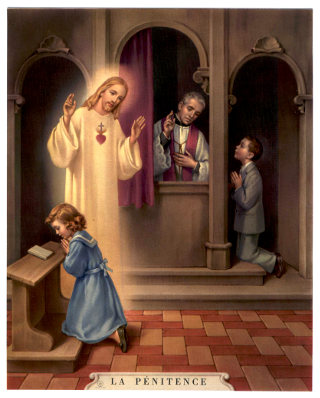
This sacrament
is the sacrament of Penance.
Jesus instituted
this sacrament after His resurrection
from the dead, when He said to the apostles,
" Receive ye the Holy Ghost : whose sins you
shall forgive, they are forgiven them ; and
whose sins you shall retain, they are retained."
1
Again, at another time, He told His apostles,
" Whatsoever you shall bind upon earth,
shall be bound also in heaven ;
and whatsoever you shall loose upon earth,
shall be loosed also in heaven."
2 Christ has
given His apostles and their successors,
the bishops and priests of the Catholic
Church, the power to forgive sins in His
name. This power is exercised in the sacrament
of Penance, where the sins are forgiven through
the absolution of the priest, whenever any one
is heartily sorry for his sins, confesses them sincerely,
and is willing to make satisfaction for them.


1 John 20. 23.
2 Matt. 18. 18.


To be continued...
Avatar de l’utilisateur
InHocSignoVinces
Messages : 2999
Inscription : dim. 26 août 2018 11:43
Localisation : Tharsis, Hispania

Re: DIVINE GRACE (in English)

Message par InHocSignoVinces »

Through the sacrament of Penance they
that have had the misfortune to lose the sanctifying
grace received in Baptism can be
saved.
Penance is often called a second
plank after shipwreck. A man's life is
compared to a sea voyage: by Baptism he
is put on a ship that is to carry him safely
to the port of heaven; when he commits
a mortal sin, he is, so to speak, shipwrecked,
and unless a plank or some other object
be near him - to which he can cling, he
will certainly be drowned; no power of
his own can ever save him. The sacrament
of Penance is such a plank after shipwreck.
Penance is also called the laborious Baptism
of tears. Just as in Baptism we are cleansed
from our sins by water and the Holy Ghost,
so in penance the place of water is taken by
tears of contrition. This, however, does not mean
that we must actually weep ; we can be sorry for our sins
even without shedding tears. Tears are
a sign of sorrow, and therefore we call penance
a Baptism of tears merely to indicate
that a deep sorrow for sin is absolutely
necessary in this sacrament. In the early
days of the Church penance was much more
difficult than it is now. In those days they
that had sinned were often compelled to
do public penance for their sins ; they had to
remain for months, and even years, outside
the church doors during some parts of
the Mass, ask the prayers of those that
entered the church, and so profess themselves
to all the people as sinners. Today the
priest still gives a penance to be performed,
for this is a part of the sacrament; but the
penances are much lighter and rarely public.


To be continued...
Avatar de l’utilisateur
InHocSignoVinces
Messages : 2999
Inscription : dim. 26 août 2018 11:43
Localisation : Tharsis, Hispania

Re: DIVINE GRACE (in English)

Message par InHocSignoVinces »

The Church has always believed that
sins committed after Baptism are forgiven
through the sacrament of Penance, and has
at all times administered this sacrament.
For the worthy reception of this sacrament
the sinner must do something on his part,

in order that he may again obtain the
grace of God.
To regain justification, lost
by mortal sin, he must believe, hope, begin
to love God, and repent of his sins, and then
receive the sacrament of Penance.


As in the justification of one who is not
baptized, so also in the justification of one
who has lost sanctifying grace by mortal
sin, God makes the beginning.
God, by
His grace, calls the lost sheep; He invites
him to return.
The occasion may be a
sermon, an instruction, the voice of the
priest or of a friend, a missionary, or it may
be the voice of conscience.
The grace of
God is internal,
but He often joins it to
some sign or event.
The sinner must obey
this call of the grace of God ; if he neglects
it, he cannot be justified without it. He
must allow himself to be led by the grace
of God ; under its influence he must believe
in Jesus and hope for His forgiveness.
Faith is the root from which all justification
springs ; without faith we can do nothing
to please God. If we believe in Jesus
and His infinite mercy, we will also hope
in His forgiveness.
Then if we are sorry
for our sins and resolve to avoid sin in the
future,
we are beginning to love God.


To be continued...
Image
Avatar de l’utilisateur
InHocSignoVinces
Messages : 2999
Inscription : dim. 26 août 2018 11:43
Localisation : Tharsis, Hispania

Re: DIVINE GRACE (in English)

Message par InHocSignoVinces »

Now that the sinner has, with the help
of divine grace, prepared his soul by these
acts for the reception of sanctifying grace,
he must receive the sacrament of Penance.
Christ ordained this by the words which
He spoke to His apostles, "Whose sins,"
etc.1 By these words Jesus instituted
the sacrament of Penance, and ordained
that the priest examine into the state of
the soul of the penitent and forgive him
his sins in the name of Jesus Christ if he
finds him properly disposed. It is true
sins can be forgiven also without the actual
reception of the sacrament of Penance
by
an act of perfect contrition,
that is, by sorrow
for sin out of the motive of the love of
God;
but there must always be included
in this contrition the resolution of confessing
one's sins as soon as possible. It is
impossible to be sorry for one's sins out
of the motive of the love of God, without
wishing to comply also with the commandments
He has given. God has ordained
that the ordinary way to receive forgiveness
of the sins committed after Baptism
is the sacrament of Penance ; hence perfect
contrition forgives sins only when we are
willing to comply with the ordinary arrangements
God has made for the remission of sin.


We have indeed cause to be grateful to
God for the institution of the sacrament
of Penance; for how few there are who
retain pure and unsoiled the garment of
baptismal innocence ! How few there
would be to obtain the kingdom of heaven
if God had not made provision for the
forgiveness of the sins committed after
Baptism!
This sacrament, therefore, is a
testimonial of the mercy and goodness of
God toward us. By means of it the obtaining
of eternal happiness has been made
comparatively easy. After our ingratitude,
God could have prescribed most difficult
conditions for the regaining of sanctifying grace,
but He has preferred to make the return to Him
possible, and even easy, for every one.

All that He requires is that we detest our sins,
resolve to serve Him faithfully in the future,
confess our sins to His representative, *
and accept the penance imposed on us by him.


It is true it may seem difficult to some to confess
their sins to another; but sin is an act of
rebellion and pride,
and is therefore most
appropriately forgiven by an act of humility.

With the help of the grace of God, the
false shame which would keep us from telling
our sins can be overcome ; we must take
this medicine, which may seem a little bitter
at times, if we wish to regain the health of
the soul. Besides, God has ordained that
these sins shall never be revealed by the
priest. The priest must suffer death rather
than make known the least sin heard in
confession.


1 John 20. 22.


* Nota de Fray Javier del Espíritu Santo: No habiendo ya ningún representante de Dios válido y lícito a quien confesar nuestros pecados, al Pequeño Rebaño de fieles que formamos lo poco que todavía subsiste de la Iglesia Católica nos corresponde realizar numerosos actos de contricción perfecta cada vez que tengamos la desgracia -Dios no lo quiera- de cometer algún pecado mortal o venial. El arrepentimiento y el dolor por haber ofendido a Ntro. Dios y Señor deben ser intensos y sinceros, hermanos míos, debemos dolernos en lo más hondo de nuestra alma por haber despreciado y abusado de la gracia de Dios por un vil y miserable capricho, placer, orgullo o cualquier otro desorden. Debemos pedirle a Dios mediante la misericordiosa intercesión de María Santísima que nos perdone por los méritos infinitos de Su dolorosa Pasión y Muerte, y que lave y borre nuestros pecados con Su Preciosa Sangre. Entremos cada uno en nuestra habitación y a solas, en el silencio, lloremos por tanta ingratitud nuestra hacia Aquél que se entregó a Sí mismo para que nosotros, miserables y débiles criaturas, tuviéramos vida eterna en abundancia. Después, una vez hecha la confesión ante Nuestro Salvador y Redentor, ofrezcámosle una digna penitencia en reparación por nuestras ofensas, y en unión con Su Pasión y Muerte en la Cruz por nosotros. El ayuno es una buena penitencia, y la limosna lo es incluso más. ¡La limosna lava los pecados y los borra! Seamos generosos y demos limosna, mucha limosna a los pobres, porque quien da a los pobres está prestando a Dios, el cual es el mejor pagador y el más justo y misericordioso de todos.

To be continued...
Image
Avatar de l’utilisateur
InHocSignoVinces
Messages : 2999
Inscription : dim. 26 août 2018 11:43
Localisation : Tharsis, Hispania

Re: DIVINE GRACE (in English)

Message par InHocSignoVinces »

After Baptism there is no remedy for
sin except the sacrament of Penance.
We
may fast, give alms, pray, perform the greatest
works of piety, but unless we are willing
to confess our sins, and so comply with
the will of God, it is all in vain.
God has
willed this, and His will must be done.
If,
on the contrary, after proper preparation,
we confess our sins candidly to the priest,
and he, by the power given him by Jesus
Christ, says, " I absolve thee from thy sins,
in the name of the Father and of the Son
and of the Holy Ghost,"
then our sins are
forgiven,
and sanctifying grace again enters
our souls; we are once more children of
God ; once more heaven is our right.
Then
we should rejoice and thank God with
the Psalmist : " Bless the Lord, O my soul ;
and let all that is within me praise His
holy name. Bless the Lord, O my soul;
and never forget all He hath done for
thee: who forgiveth all thy iniquities; who
healeth all thy diseases; who redeemeth
thy life from destruction; who crowneth
thee with mercy and compassion."
1


1 Psalm 102. 1-4.


Coming next... ON THE INFUSED VIRTUES IN GENERAL, AND
ON FAITH IN PARTICULAR
Image
Avatar de l’utilisateur
InHocSignoVinces
Messages : 2999
Inscription : dim. 26 août 2018 11:43
Localisation : Tharsis, Hispania

Re: DIVINE GRACE (in English)

Message par InHocSignoVinces »

V - ON THE INFUSED VIRTUES IN GENERAL, AND
ON FAITH IN PARTICULAR - THE INFUSED VIRTUES


What do you call those graces or gifts of God by which
we believe in Him, hope in Him, and love Him ?

Those graces or gifts of God by which we believe in
Him, hope in Him, and love Him, are called the divine
virtues of faith, hope, and charity.


By sanctifying grace man is justified, that
is, all his sins are remitted, and he is interiorly
sanctified and made pleasing to God ;
he becomes a child of God, and has a right
to the eternal happiness of heaven. As a
child and servant of God, he must know
God, his Father and Lord, he must hope for
the reward which God has promised him for
his fidelity, and he must love God above all
things. All these things follow from sanctifying
grace, which makes us children of
God. Hence the catechism asks in this
place the question, " What do you call
those graces or gifts of God by which we
believe in Him, hope in Him, and love
Him?"


"Those graces or gifts of God by which we
believe in Him, hope in Him, and love Him,
are called the divine virtues of faith, hope,
and charity."


The catechism calls them graces or gifts
to indicate that, just like grace, they are
given without any merit on our part, purely
through the mercy and goodness of God.
Without sanctifying grace we do not have
the virtues of faith, hope, and charity.
Now we know that sanctifying grace is
a free gift of God ; the virtues, therefore,
which are infused, that is, poured into the
soul, with it, and on account of it, are also
gratuitous. God gives them to us without
any merit of our own. Through sanctifying
grace God gives us a supernatural life; life
shows itself in actions. We have our natural
life through the soul, which is the source of
life ; this life shows itself through the acts of
our faculties, — we walk, we think, we will —,
and by these actions it is known that we
have life ; they are its manifestations. Grace
raises our soul to a supernatural life ; this
life, too, must manifest itself in some acts;
it, too, must bring with it its supernatural
inclinations. These supernatural inclinations
are the divine virtues of faith, hope, and
charity; by means of them we can believe,
hope, and love God, in a supernatural manner,
just as we can know and love Him
naturally by means of our natural faculties
of understanding and will. Grace raises the
soul itself to the supernatural order, and the
divine virtues elevate the faculties of intellect and will.


To be continued...
Répondre

Revenir à « Texts in English »

Qui est en ligne ?

Utilisateurs parcourant ce forum : Ahrefs [Bot] et 0 invité